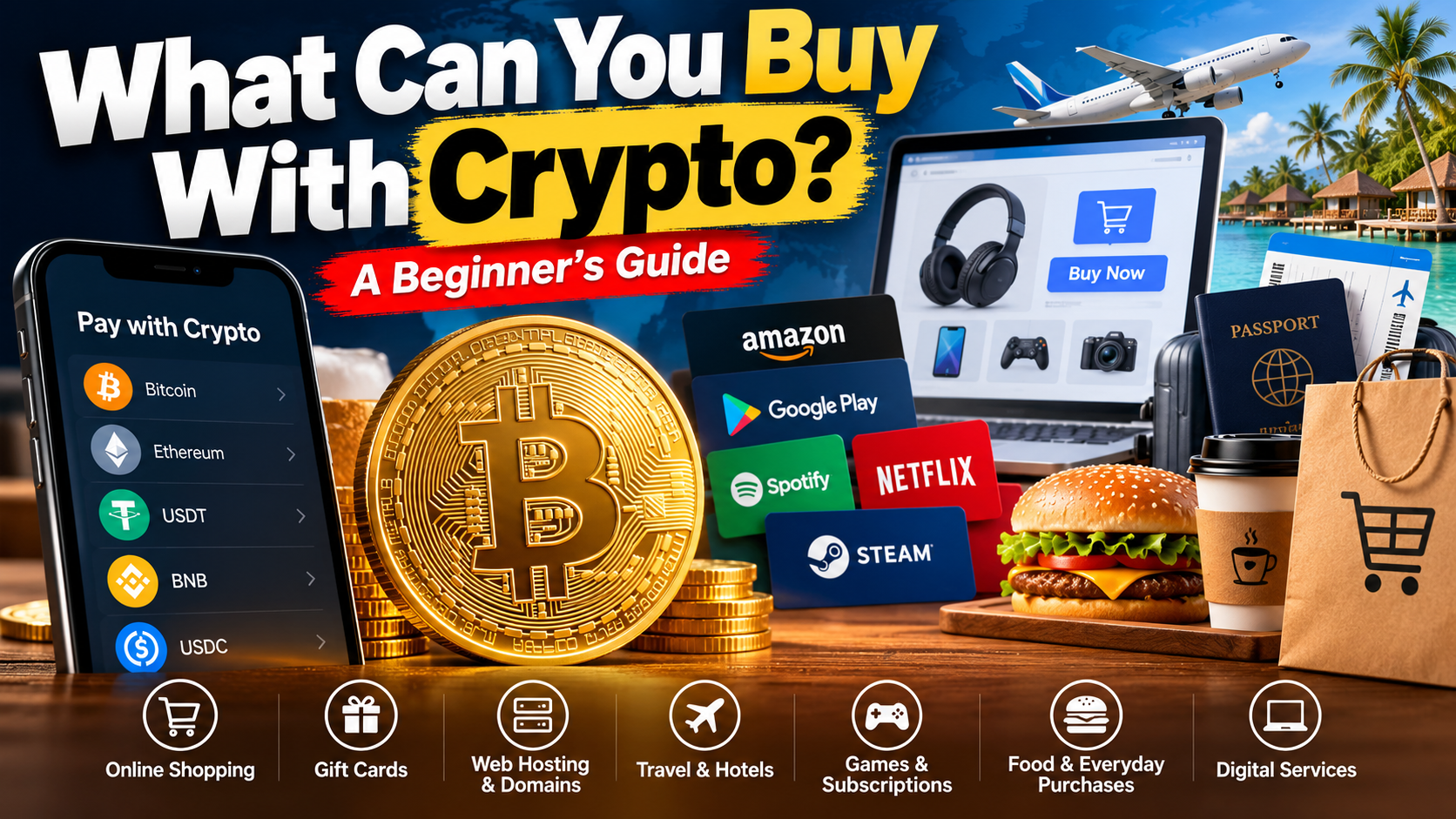

Cryptocurrency is no longer used only for trading or long-term investing. Depending on the country, payment provider, and merchant, you may also be able to use Bitcoin and other cryptocurrencies to pay for online services, gift cards, travel bookings, and selected everyday purchases.
However, not every business accepts cryptocurrency directly. Some businesses use third-party payment processors, while others allow customers to spend crypto through gift cards or crypto-linked payment cards.
In this guide, you will learn what you can buy with crypto, how cryptocurrency payments work, and what to check before sending digital assets to a merchant.
What Can You Buy With Crypto?
Depending on the merchant and your location, cryptocurrency can be used to purchase several types of products and services.
- Online products and selected electronics
- Gift cards for participating retailers
- Web hosting, domains, and digital services
- Travel bookings and selected accommodation services
- Games, digital subscriptions, and online content
- Food and everyday purchases from participating businesses
- Selected services through crypto payment cards
Availability varies. Before making a purchase, check the merchant's official checkout page to confirm which cryptocurrencies, networks, and payment methods it currently supports.
1. Online Products and Electronics
Some online retailers accept cryptocurrency directly or through a third-party payment processor. Depending on the retailer, eligible products may include electronics, computer accessories, household products, and other physical goods.
Crypto acceptance can change over time. A retailer may support Bitcoin through a payment processor without accepting other digital assets, or it may offer crypto payments only in certain countries.
Before buying: Confirm that cryptocurrency is available as a payment option at checkout. Also review shipping costs, return policies, refund methods, and any conversion fees.
2. Gift Cards
Gift cards are another way to spend cryptocurrency. Some gift-card platforms allow eligible customers to pay with supported digital assets and receive a gift card for a participating brand.
Depending on the platform and country, available gift cards may cover:
- Online shopping
- Gaming and entertainment
- Food delivery
- Travel and hospitality
- Selected retail brands
Gift-card availability, denominations, and payment options differ by country. Check the platform's official terms before paying, and make sure the gift card is valid in your region.
Gift cards can also be difficult or impossible to refund after delivery. Only use reputable services, and never buy gift cards to pay someone who threatens you or promises guaranteed investment returns.
3. Web Hosting, Domains, and Digital Services
Some technology providers and digital-service businesses accept cryptocurrency. Depending on the provider, these services may include:
- Website hosting
- Domain registration
- Virtual private servers (VPS)
- Software and digital tools
- Selected privacy or online infrastructure services
This category can be useful for website owners, developers, and online businesses. However, crypto acceptance is provider-specific. Check the payment page and supported networks before transferring funds.
4. Travel and Accommodation
Some travel providers and booking services offer cryptocurrency payments directly or through payment partners. Depending on the service and destination, eligible purchases may include flights, accommodation, or other travel-related products.
Other booking platforms may not accept crypto directly but could support an eligible third-party payment method. Do not assume that a hotel, airline, or travel website accepts Bitcoin simply because a payment service advertises crypto support.
Before booking, review cancellation rules, refund conditions, exchange-rate calculations, and whether the final booking confirmation is issued immediately.
5. Games, Entertainment, and Digital Content
Some gaming platforms, digital-content providers, and online entertainment services support cryptocurrency payments or crypto-funded gift cards.
Depending on the platform, you may be able to purchase eligible game credits, subscriptions, or digital products. Availability depends on the service's current payment policy and your location.
Check whether the payment is for a subscription renewal or a one-time purchase. Also confirm whether refunds, chargebacks, or account-credit reversals are available, since cryptocurrency transactions generally cannot be reversed by the sender once confirmed on the blockchain.
6. Food and Everyday Purchases
Some restaurants, cafes, online merchants, and local businesses accept cryptocurrency. Acceptance is not universal, and a business may support crypto payments at one location but not another.
In some places, people use a crypto-linked payment card to make purchases at merchants that accept the card's underlying payment network. This is different from paying the merchant directly with Bitcoin: the card provider may convert or otherwise process the crypto-funded balance under its own terms.
Before using this method, check the provider's fees, supported countries, conversion rates, spending limits, and tax implications.
7. Products and Services Through Crypto Payment Cards
Some providers offer payment cards linked to cryptocurrency accounts. Where supported, these cards may let eligible users spend a balance at merchants that accept the card network.
Depending on the provider, the process may involve converting cryptocurrency into fiat currency when a transaction takes place. Other products may use a prepaid balance or a different funding arrangement.
Read the cardholder agreement carefully. Consider foreign-exchange fees, withdrawal fees, spending limits, asset-conversion rules, account restrictions, and the provider's availability in your country.
What Can You Buy With Bitcoin vs. Other Cryptocurrencies?
What you can purchase depends more on the merchant's payment support than on the cryptocurrency itself. A business that accepts Bitcoin may not accept Ether, stablecoins, or other tokens.
| Payment method | Potential use | What to check |
|---|---|---|
| Bitcoin (BTC) | Purchases from merchants that support BTC | Network, fees, payment deadline |
| Ether (ETH) | Purchases from merchants that support ETH | Network fees and supported network |
| Stablecoins | Payments where a specific stablecoin is accepted | Exact token, network, redemption and issuer risks |
| Crypto-linked card | Eligible purchases at participating card-network merchants | Fees, conversion terms, card availability |
Never select a cryptocurrency or blockchain network based only on its name. The asset and network must match the payment instructions provided by the merchant.
How to Pay for Something With Cryptocurrency
The exact process depends on the merchant, but a typical direct crypto payment follows these steps.
- Choose a merchant: Confirm that it accepts your intended cryptocurrency in your country.
- Select crypto at checkout: Choose the supported asset and payment network shown by the merchant.
- Review the payment details: Check the amount, recipient address, network, exchange rate, and payment deadline.
- Open your wallet: Use a trusted wallet that supports the required cryptocurrency and network.
- Verify before sending: Carefully check the destination address and amount. For a large payment, consider a small test transaction if practical.
- Submit the transaction: Approve it only after checking all details.
- Save the receipt: Keep the merchant's order confirmation and transaction ID for your records.
If you are unfamiliar with wallet addresses, read our guide to what a crypto wallet address is before making a payment.
Important Risks Before Spending Crypto
1. Transactions Are Generally Irreversible
Once a blockchain transaction is confirmed, it generally cannot be cancelled or reversed by the sender. A merchant or recipient may voluntarily return funds, but a refund is not guaranteed.
2. Network Fees Can Change
Transaction fees vary by blockchain, network conditions, and the wallet or service used. Check the total cost before confirming the payment.
3. Prices Can Fluctuate
The fiat value of many cryptocurrencies can change quickly. A product's crypto-denominated price or the amount required at checkout may therefore differ from what you expected.
4. Tax Rules May Apply
Spending cryptocurrency may have tax consequences, even if you are buying an ordinary product. The rules depend on your tax residence and local law. Keep transaction records and consult a qualified tax professional if necessary.
5. Protect Your Wallet
Never share your seed phrase or private key with a merchant, support agent, or payment service. A legitimate payment should not require you to reveal the secret recovery information for your wallet.
Learn how to store a seed phrase safely and understand the role of a hardware wallet before holding or spending substantial amounts of cryptocurrency.
Is It Better to Spend Crypto or Hold It?
There is no universal answer. Spending crypto can be convenient when a trusted merchant supports it and the total cost is reasonable. However, using a volatile asset for everyday purchases can introduce price risk, fees, recordkeeping obligations, and potential tax consequences.
Before spending, consider these factors:
- Whether the purchase is necessary and affordable
- The total cost after network and service fees
- Whether the asset might fluctuate significantly in value
- The merchant's refund and cancellation policy
- Applicable tax and reporting requirements
Do not spend money you cannot afford to lose, and do not assume that cryptocurrency will increase in value over time.
Frequently Asked Questions
Can you buy everyday things with crypto?
Yes, in some locations. Participating businesses may accept crypto directly, while other purchases may be possible through eligible gift cards or crypto-linked payment cards. Availability depends on the provider and country.
Can I buy things online with Bitcoin?
Yes, if an online merchant supports Bitcoin directly or through an eligible payment provider. Check the merchant's official checkout page before sending funds.
Can I use crypto to buy food?
Some restaurants, food businesses, and delivery services support cryptocurrency or eligible crypto-funded payment methods. Acceptance varies by location and provider.
Can I buy a gift card with cryptocurrency?
Some gift-card platforms accept supported cryptocurrencies. Check the platform's country restrictions, fees, brand availability, and refund terms before purchasing.
Is paying with crypto safe?
It can be done safely when you use a trusted wallet and merchant, verify the recipient address and network, and protect your private keys. However, blockchain payments generally cannot be reversed by the sender, so mistakes and scams can result in permanent losses.
Do I have to pay tax when I spend cryptocurrency?
Possibly. Spending crypto can be treated as a taxable disposal in some jurisdictions. The treatment depends on local law and your circumstances, so keep accurate records and seek professional advice when needed.
Final Thoughts
Cryptocurrency can be used for more than trading. Depending on your location and the merchant's current payment options, you may be able to purchase digital services, gift cards, travel products, electronics, and selected everyday items.
The most important step is to verify payment support before sending funds. Check the asset, blockchain network, amount, fees, and refund policy, and never disclose your private key or seed phrase to complete a purchase.
For more beginner-friendly guidance, explore our articles on seed phrases, decentralized wallets, and recovering a crypto wallet.
Disclaimer: This article is for educational purposes only and is not financial, investment, or tax advice. Cryptocurrency payment availability, fees, and legal requirements vary by country and provider.