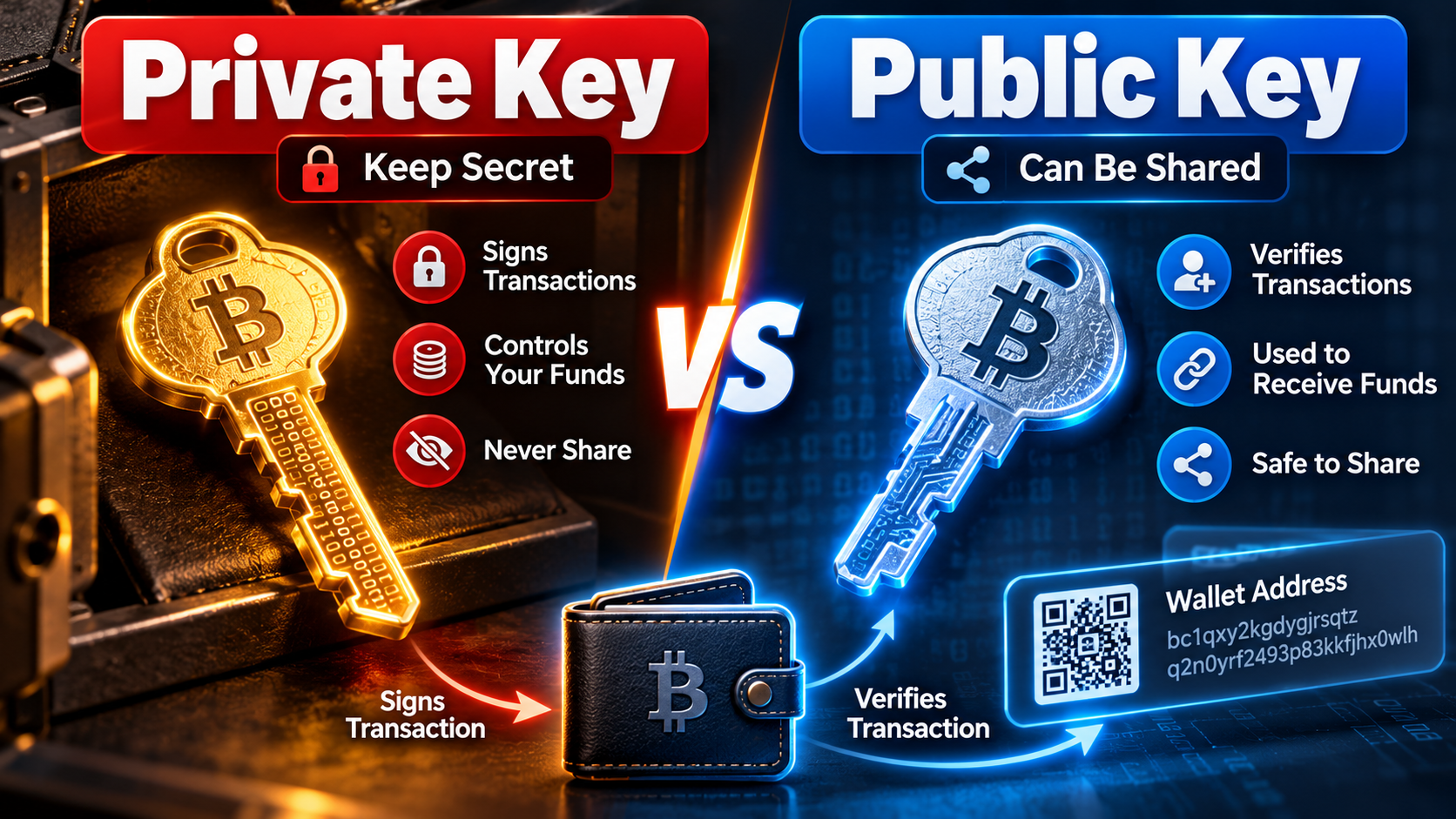

Public keys and private keys are two fundamental parts of cryptocurrency security. They work together to help users receive digital assets, authorize transactions, and prove control over funds without revealing their secret credentials.
If you are new to cryptocurrency, these terms can sound confusing. A public key can be shared in certain situations, while a private key must remain secret. Understanding the difference is essential for managing a crypto wallet safely.
In this guide, you will learn what private and public keys are, how they work, how they relate to wallet addresses, and how to protect them from common security threats.
What Is a Private Key in Crypto?
A private key is a secret cryptographic value that allows its holder to authorize certain cryptocurrency transactions. In a typical self-custody wallet, the private key is used to create a digital signature that proves a transaction was authorized by someone controlling the key.
Private keys are usually generated using secure cryptographic methods. They must be protected because anyone who obtains a usable private key may be able to authorize transactions for the assets associated with it.
A private key is not the same as a wallet password or a recovery phrase. A wallet may use a recovery phrase to derive multiple private keys, while a password may protect access to an application or encrypted wallet data.
Learn more in our guide to what a seed phrase is.
What Is a Public Key in Crypto?
A public key is a cryptographic value derived from a corresponding private key. It is used in public-key cryptography to verify digital signatures or perform other cryptographic operations, depending on the system.
Public keys are designed to be shareable where the relevant protocol requires them. Knowing a public key should not allow someone to calculate its corresponding private key with currently practical methods when secure algorithms and adequate key sizes are used.
In cryptocurrency, public keys and their associated addresses help other people send assets to you or verify that a transaction has been authorized. The exact relationship between a public key and a wallet address depends on the blockchain.
Private Key vs. Public Key: Key Differences
The most important difference is that a private key must remain secret, while a public key is designed to be shared when needed.
| Feature | Private Key | Public Key |
|---|---|---|
| Purpose | Used to create digital signatures or authorize cryptographic operations | Used to verify signatures or perform supported public-key operations |
| Confidentiality | Must remain secret | Can generally be shared when required by the protocol |
| Generation | Generated securely using cryptographic methods | Derived mathematically from the private key |
| Transaction role | Authorizes transactions by producing a valid signature | Helps verify the signature, depending on the blockchain's cryptographic scheme |
| Can it be shared publicly? | No. Revealing it can compromise control of associated funds | Generally yes, although privacy considerations may still apply |
| Can it be used to derive the other key? | It can be used to derive its corresponding public key | It should not feasibly reveal the private key when secure cryptography is used |
| Security risk | Exposure may allow unauthorized transactions | Exposure alone does not normally allow spending funds |
These roles are common in public-key cryptography, but implementation details vary by blockchain, signature algorithm, and wallet design.
How Do Private and Public Keys Work Together?
Private and public keys are mathematically related. A wallet can use the private key to sign a transaction, while the corresponding public key allows the network to verify that signature under the relevant cryptographic rules.
- Key generation: A wallet generates a private key using a secure process and derives its corresponding public key.
- Address creation: Depending on the blockchain, the public key may be transformed or hashed to create a wallet address or another identifier used for receiving funds.
- Transaction preparation: The wallet prepares a transaction specifying details such as the recipient, amount, and network-specific information.
- Transaction signing: The wallet uses the private key to produce a digital signature.
- Verification: The blockchain network checks the signature and other transaction rules. The exact verification process differs across blockchain protocols.
- Transaction processing: If the transaction meets the network's requirements, it can be accepted and included in the blockchain.
The private key does not need to be sent to the blockchain network. A correctly implemented wallet can sign a transaction while keeping the private key secret.
What Is the Difference Between a Public Key and a Wallet Address?
A public key and a wallet address are related, but they are not necessarily the same thing.
A public key is a cryptographic value. A wallet address is an identifier used by a blockchain protocol to direct payments or identify a destination for assets. Depending on the blockchain, an address may be derived from a public key, a hash of a public key, a script, or another protocol-specific structure.
For example, many Bitcoin address formats are derived from public-key-related data or scripts. Ethereum externally owned account addresses are derived from the public key using a defined hashing process. Other blockchain systems may use different address formats and account models.
This is why you should always use the receiving address generated for the specific asset and network you intend to use.
Read our guide to what a crypto wallet address is for more details.
Can Someone Steal Your Crypto Using Only Your Public Key?
In a properly implemented public-key cryptographic system, knowing a public key alone should not allow an attacker to calculate the corresponding private key or authorize transactions as the key holder.
However, sharing a public key may reveal information about your blockchain activity, depending on the network and how the key is used. Some public keys or addresses can be linked to transaction histories that are visible on a public blockchain.
There are also other risks that public-key secrecy does not solve. An attacker may try to steal your recovery phrase, compromise your device, trick you into signing a malicious transaction, or exploit a vulnerable wallet application.
Therefore, protecting your private key and verifying transactions remain essential even when your public key is safe to share.
What Happens If You Lose Your Private Key?
If a private key is lost and no valid recovery method exists, the assets controlled by that key may become permanently inaccessible. There is generally no central authority that can reset a self-custody private key for you.
However, some wallets derive multiple private keys from a recovery phrase. If you have the correct recovery phrase and follow a compatible recovery process, you may be able to restore the wallet's keys.
Recovery depends on the wallet's derivation method, account configuration, any additional passphrase, and the blockchain or wallet standard involved. A backup should therefore be created and stored according to the wallet provider's instructions.
Read our guides on using a seed phrase to recover a crypto wallet and storing a seed phrase safely.
How to Protect Your Private Key
Follow these security practices when managing a self-custody cryptocurrency wallet:
- Never share your private key: Legitimate wallet support teams should not need your private key or recovery phrase.
- Protect your recovery phrase: Keep it private and offline in a secure location. Anyone who obtains it may be able to restore access to the keys it controls.
- Use a reputable wallet: Research wallet security, supported assets, and the authenticity of the software or hardware before use.
- Consider hardware-based key protection: A reputable hardware wallet can keep private keys isolated from a connected computer or phone when properly configured.
- Verify transaction details: Check the recipient address, amount, network, and relevant signing information before approving a transaction.
- Avoid phishing links: Do not enter private keys or recovery phrases into websites, forms, or applications you do not trust.
- Maintain secure backups: Understand how wallet recovery works and protect backups against theft, damage, and unauthorized access.
- Use a separate wallet for higher-risk activity: Consider limiting the funds exposed to decentralized applications and frequent transactions.
For more information, read our guide to what a hardware wallet is.
Private Keys, Public Keys, and Seed Phrases: How Are They Related?
These three concepts are connected but serve different purposes.
| Term | What It Does | Should You Keep It Secret? |
|---|---|---|
| Private key | Authorizes supported cryptographic operations, including transaction signing | Yes, always |
| Public key | Supports signature verification and other public-key operations | It can generally be shared when required |
| Seed phrase | Can restore a wallet and derive its associated keys when used with the correct wallet standards and settings | Yes, always |
| Wallet address | Identifies a destination for receiving assets under a blockchain's rules | Generally shareable for receiving funds |
A seed phrase can provide access to multiple derived keys, so exposing it may compromise more than one address or account. A public key or receiving address does not normally provide the same ability to spend funds.
Learn more about seed phrases and decentralized wallets.
Frequently Asked Questions
1. What is the main difference between a private key and a public key?
A private key is secret and can authorize transactions by creating digital signatures. A public key is derived from the private key and can be used to verify signatures or perform other public-key operations.
2. Is it safe to share a public key?
Public keys are generally designed to be shared when needed. However, sharing them may reveal information about transaction activity, depending on the blockchain and how the key is used.
3. Can someone access my crypto with my public key?
A public key alone should not allow someone to derive its corresponding private key using currently practical methods when secure cryptography is used. Protect your private key, recovery phrase, and wallet devices against theft and compromise.
4. Is a public key the same as a wallet address?
No. A public key is a cryptographic value, while a wallet address is a blockchain-specific identifier used for receiving assets. An address may be derived from a public key or generated through another protocol-specific process.
5. Can I recover a lost private key?
Recovery may be possible if you have a valid backup, such as a compatible recovery phrase, and know the correct recovery procedure and settings. Without the required key material or a valid backup, access may be permanently lost.
6. Does a seed phrase contain my private key?
A seed phrase is generally used to derive wallet keys rather than simply being a written copy of one private key. The exact relationship depends on the wallet's standards and configuration.
7. Does a hardware wallet store private keys?
A hardware wallet is designed to generate or protect private keys and sign transactions. The specific security design varies by device. Its purpose is to keep sensitive key material isolated from less-trusted connected systems.
8. Should I store my private key in a screenshot or cloud document?
No. Screenshots and cloud documents can be exposed through compromised accounts, malware, synchronization, or unauthorized access. Use the wallet provider's recommended secure backup method instead.
Final Thoughts
Private keys and public keys perform different but complementary roles in cryptocurrency security. A private key authorizes transactions, while its corresponding public key supports verification and other cryptographic operations. Wallet addresses provide a destination for receiving assets according to each blockchain's rules.
The most important security principle is simple: keep private keys and recovery phrases secret, verify transactions before signing, and understand how your wallet can be recovered. These practices can help reduce the risk of unauthorized access and permanent loss.
Disclaimer: This article is for educational purposes only and does not constitute financial or cybersecurity advice tailored to your circumstances. Cryptocurrency transactions may be irreversible, and managing private keys involves risks, including permanent loss of access to funds.